


Geosynthetics-Synthetic filament spunbond and needle punched nonwoven Geotextile
Filament spunbond and needlepunched
nonwoven Geotextile
Features
Geotextile, also known as geotextile, is a permeable geosynthetic material that exists between soil and pipes, gabions, or retaining walls, which enhances water movement and hinders soil movement.
Filament geotextile uses ultra-strong polyester chips as raw materials, which are made by spinning, air drafting, laying, pre-pressing, and needle punching.
- The physical properties are stable and can maintain the original properties for a long time;
- The chemical properties are stable and have strong acid and alkali resistance; good water permeability;
- It is resistant to high temperature and freezing and can adapt to different external environments;
- It is light in weight and can be packaged, transported and stored according to certain requirements, and is easy to construct.
Categories
Classified by fiber type, it is divided into long filament spunbond needle punched nonwoven geotextiles such as polyester, polypropylene, nylon, and ethylene glycol.Divided by structure: ordinary type and composite type.

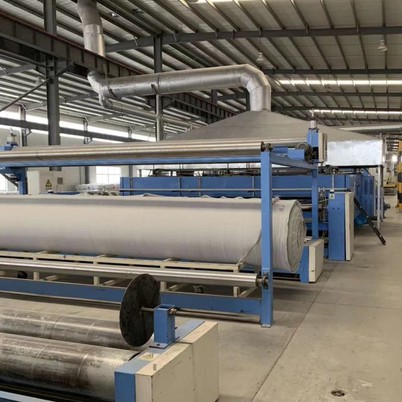
Filament non-woven fabric production process
Needle-punched non-woven fabric series products are formed through fine combing, multiple precision needle punching or appropriate hot rolling treatment. Filament needle-punched non-woven fabric is made by jet-drawing fibers through swinging and laying into a fiber web, and then pre-pressing the fiber web through hot rolling rollers and reinforcing it into cloth through needles. The needles have barbs, which repeatedly puncture the fiber web, and the hooks reinforce the fibers to form needle-punched non-woven fabrics.

Application of filament non-woven fabric products

Reinforcement effect
It can stabilize and limit the displacement of civil engineering during long-term use, and can transfer or distribute the local stress acting on the soil to a larger area, increasing the friction resistance between the soil and the geotextile.
It is mainly used in the following projects: in highways, railways, embankments, earth-rock dams, airports, stadiums and other projects, it is used to strengthen weak foundations and play the role of isolation and filtration; increase the stability of gravel slopes and reinforced soil; laying geotextiles on the foundation of construction sites can play the role of reinforcement, isolation, filtration, etc.
Isolation effect
Use geotextile to separate different soil structures, form a stable interface, separate each layer of structure, and play their own characteristics and overall role as required.
Mainly used for: isolation between railway ballast and roadbed, or isolation between roadbed and soft foundation; isolation layer between surface foundation and foundation of highway, railway, airport, parking lot, etc.; in earth-rock mixed dam, to isolate different dam materials. Earth-rock dams are built on rock foundations with developed fissures or pebble foundations, used as isolation between dam body and foundation; isolation between gabions, sandbags or earthbags and soft foundations; isolation layer between artificial fill, stone pile, or material field and foundation, isolation between different frozen soil layers; earth and stone dumped in water (rivers, lakes, seas), geotextiles are placed underwater, which plays an isolation role, and also plays a role of anti-filtration and reinforcement.


Protective effect
Polyester filament geosynthetics can protect and prevent erosion of soil or water surface.
Mainly used in the following projects: Placing geotextiles on the banks of rivers, lakes and seas can prevent erosion in water flow; prevent the spread of harmful substances such as garbage, waste, waste liquid and pollute the water or the environment; prevent evaporation of water surface or dust in the air from polluting the water surface; prevent road surface reflection cracks; prevent freezing damage to soil at low temperatures; temporarily protect the shore or grassland to prevent water loss and promote plant growth; measures taken to prevent the impact on adjacent buildings during underground engineering construction; prevent interference or damage caused by vibration of machine foundations, or explosion of arsenals to destroy life and property; prevent chemical substances from corroding and damaging engineering structures.
Filtration effect
Geotextiles can allow water to pass through and effectively prevent soil particles from passing through, thereby preventing the loss of soil particles and causing damage to the soil.
It is mainly used in the following projects: filter layer of clay core wall or clay inclined wall of earth-rock dam; filter layer of various drainage bodies in earth-rock dam (including roller compaction dam, water drop dam, underwater earth-fall dam) or embankment; filter layer of ash storage dam or ore storage dam surface; filter layer of embankment, dam, river, canal and coastal block stone


Drainage function
Polyester filament non-woven geotextile can form drainage channels in the soil, collect the water in the soil, and discharge it out of the body along the plane of the material.
It is mainly used in the following projects: vertical or horizontal drainage inside earth dams; drainage behind the anti-seepage geomembrane in earth dams or earth embankments or under the concrete face; dissipation of pore water pressure in the soil; vertical drainage in weak treatment; drainage behind the retaining wall; drainage around various buildings; elimination of seepage around tunnels and reduction of external water pressure on the lining; drainage of artificial fill foundations or sports field foundations.
Seepage prevention effect
Geotextile and geomembrane composite geotechnical materials can prevent liquid leakage, gas volatilization, and protect the environment or building safety.
Mainly used in the following projects: earth-rock dam surface, dam body seepage prevention, upstream blanketing or reservoir area seepage prevention measures; vertical seepage prevention of earth dam or sluice foundation or vertical seepage prevention of underground reservoir; upstream protection tank of sluice, anti-slope seepage prevention. Seepage prevention of confluence; low-pressure input pipelines in irrigation areas; seepage prevention measures of culverts buried in embankments around tunnels; inflatable film dams, pile film cofferdams; seepage prevention of drinking water pools, swimming pools, fish and duck ponds, sewage pools, salt field brine pools, storage tanks for various chemical solutions, oil storage tanks, etc.; seepage prevention of basements, underground warehouses, underground garages, air raid roads, and other buildings; seepage prevention and moisture-proof measures; layer top seepage prevention; sewage river, oil transportation channel, various industrial waste channels for water transportation. Seepage prevention of solid waste dumps; sealing of expansive soil, cutting off the source of frozen heaving soil.

Other functions
Filament non-woven geotextiles can be combined with other geosynthetics such as geogrids, geomembranes, and drainage nets to form composite geotextiles. Composite geotextiles can combine the properties of different materials to better meet the needs of specific projects and can play a variety of functions. For example, composite geogrids are composite geotextiles made by heating and bonding geotextiles and plastic geogrids. Geogrids have a high tensile modulus and can provide strong solidification and reinforcement. At the same time, non-woven fabrics ensure the filtration function of composite materials. Another example is composite drainage nets, which are composite drainage materials composed of non-woven geotextiles and drainage nets. The combination of geotextiles (anti-filtration effect) and three-dimensional geotextile drainage nets (drainage and load dispersion functions) provides a complete anti-filtration, drainage, and protection system. Geotextiles can provide the function of water/soil filtration layers and prevent clay and the filler above from being embedded in the drainage net core, thus ensuring its long-term drainage capacity.


