


Landfill construction plan
Landfill construction plan
Preparation
According to the actual situation of the site combined with our years of construction experience of similar projects, due to the existing construction conditions on site, large-scale construction is impossible. In view of the characteristics of this project, we have carefully studied the actual situation of the site for many times, and combined with the construction drawings. Request the construction plan of this project.
The construction of this project includes two parts: civil engineering and anti-seepage engineering. The civil engineering mainly includes the construction of the site leveling system and the landfill ring road project; the anti-seepage project mainly includes the landfill anti-seepage system, leachate drainage Construction and installation of the system, groundwater drainage system, and landfill gas collection and drainage system. Since civil engineering and anti-seepage belong to two different professions, we will require each construction team to show their strengths, divide labor and cooperate, and coordinate internally, which can avoid the poor coordination between civil engineering and anti-seepage construction teams in the construction of similar projects in the past. This leads to delays in the construction period and affects the quality of the project.
2. The daily construction volume and operation time plan of the anti-seepage project
2.1 Construction volume plan
According to the bidding requirements of this project, combined with the construction equipment and technical strength we have invested in this project. The daily construction volume of civil engineering is set at 5000m3, and the daily construction volume of anti-seepage works is set at 3000m2. This number is the average number of actual working days during the construction period. There is a running-in process in the early stage of construction, and the construction speed will be relatively slow. After the running-in period, the construction speed will gradually accelerate. The anti-seepage system of this project is complex, with many procedures, large amount of engineering, and many cross-operation coordination. During the actual construction process, it should be adjusted appropriately according to the actual construction situation. The adjustment of the construction period should be consistent with the planned adjustment of the labor force and mechanical equipment, so as to realize the smooth connection between the front and rear processes and the streamlined operation. (If the owner has other requirements for the construction period, adjust it according to the actual situation).
Daily construction volume to meet the requirements of the entire project duration)
2.2 Arrangement of construction time
According to my previous construction experience, the construction time will be arranged from 6:00 in the morning to 19:00 in the evening, and a two-hour work and rest time will be arranged at noon.
construction schedule
|
6:00—11:30 |
Construction time |
|
11:30—13:00 |
Lunch break |
|
13:00—17:00 |
Construction time |
If the owner has other working time arrangements, he will actively cooperate, adjust the working time, and obey the overall work schedule of the landfill.
3. The main construction methods of each sub-item project
A Construction Precipitation
The groundwater level of this project is relatively high. According to the situation of the site, the precipitation method is selected with the precipitation of large wells as the auxiliary and the precipitation of light wells as the supplement.
Construction drainage requirements: During the construction, it should be ensured that the precipitation is in the front and the trenching is behind, and the dry trenching operation is always maintained. Do a good job in the drainage and drainage of surface water and rainwater to prevent surface water from flowing into the trench. To ensure continuous and stable drainage throughout the construction period.
Light Well Site Dewatering
According to the characteristics of the soil layer and the depth of lowering the groundwater level, it is selected comprehensively.
A.1 Light well point construction requirements
(1) The well point well pipes can be arranged in single row, double row or annular arrangement. Before the well point construction, do the on-site pumping test to determine the dewatering route and submit it to the supervision engineer.
(2) The excavation depth of the foundation pit shall be controlled above 0.5 meters of the precipitation water level. The control point of the annular and double-row well points is in the center of the foundation pit or trench, and the single-row well points are controlled at the bottom edge of both sides of the foundation pit.
If the water suction main pipe of the well point crosses the traffic crossing, take measures to prevent crushing, so as to ensure the normal operation of the well point system and meet the traffic requirements.
(4) The location of the pump body shall be arranged, taking into account the impact of well point precipitation on adjacent buildings and pipelines. The water from the well point must comply with the regulations, and it is strictly forbidden to flow or penetrate into the soil layer. Set up observation wells within the precipitation range, the number and location of which are included in the well site construction design and sent to the supervision engineer for approval.
(5) The well pipe of the observation well should be installed in the same aquifer and at the same depth as the well point pipe, and should be inspected (such as test pumping after watering) to make the observation results reliable.
B Earthwork Construction
B.1 Site cleaning
It is divided into vegetation clearing and topsoil clearing. This includes the surface of all areas that need to be cleared for construction land, such as permanent and temporary works, site storage areas, and sites designed to be used as stockpiles.
Clean up tree roots, weeds and other obstacles specified by the supervision engineer in the excavation project area.
The vegetation clearing on the surface of the construction site of the project in the reservoir area shall be extended to the maximum excavation shown in the construction drawing.A distance of at least 5m from the outside of the edge line or the edge line of the building foundation (or the foot of the filling slope).
For the vegetation clearance of the project in this reservoir area, the range of tree roots that must be excavated extends to a distance of 3m from the maximum excavation edge line, filling line or the outside of the building foundation shown in the construction drawing.
All non-valued combustibles shall be incinerated as soon as possible, and necessary fire prevention measures shall be taken.
(5) All the removals that cannot be burnt up or that seriously affect the environment shall be buried in the area designated by the owner.
B.2 The measurement line
Before the start of construction, the owner shall organize relevant departments and construction units to hand over piles and lines, and provide measurement and control points. After the pile is connected, the construction unit should re-measure the stable position, number and direction of the main piles, and should add the necessary guard piles as soon as possible, and make a handover record, so that in the case of loss and damage, timely and accurate supplementary measurement and recovery. If necessary, set up guard piles and make records as the original materials for the completion of the project.
According to the leveling point provided by the owner, a temporary leveling point shall be measured every 100 meters, and the closure difference shall be less than the allowable error before it can be used. Temporary benchmarks, axis control lines, and elevation piles that should be set must be attached before they can be used, and should be checked frequently. All measuring instruments shall have qualified metrology marks verified periodically.
According to the requirements of the drawings, measure the current elevation, determine the excavation area and the filling area, draw a grid, and make a good record.
Draw the boundary line of the slot according to the control line, and the excavation can be carried out only after the inspection by the supervision engineer is qualified.
B.3 Earthwork backfill
B.3.1 Filling
. The backfill uses natural soil and artificially treated materials. During the construction of backfill work, compaction shall be carried out according to the design requirements to form a stable backfill area, and the materials shall not contain any substances that do not meet the requirements.
.The backfill shall not contain too much organic matter (less than 3% of the volume), and shall not contain garbage, clods, stones or other harmful substances with a diameter greater than 75 mm.
. In the leachate treatment tank area, the filler within 200mm below the surface of the construction site shall not contain organic matter, garbage, clods and stones or other harmful substances with a diameter greater than 20mm.
(4). Before backfilling, geotechnical experiments should be carried out. Field tests include moisture content, wet and dry density, and dry density.
B.3.2 Backfilling and rolling
(1). Before backfilling the foundation pit, the accumulated water and sundries in the trench should be cleaned up. The backfill soil should not contain bad materials such as gravel, garbage silt, humus, frozen soil, etc. For the backfilling of trenches with large water content, Mixed with appropriate proportion of stone
Ash is processed.
. Backfilling should be carried out in layers from high to low in the direction of base drainage, and the order is deep and then shallow. Compacted with a road roller.
. The thickness of each layer of soil and the number of compaction times should generally be determined by on-site compaction tests. The thickness of each layer of soil for manual compaction should not be greater than 200mm, and the number of compaction times should be 3-4; , the number of compaction times is 6-8, and other mechanical rolling inspection specifications are used. When filling soil is taken, the moisture content of the backfill soil should be within the optimal moisture content range, and the difference between the two should be controlled within the range of 4%-2%. Otherwise, the backfill soil should be effectively treated, and the soil should be loosened and dried or mixed with pellets and lime.
. The backfill construction should be horizontally layered and the whole piece of backfill should be rolled or compacted. When it is necessary to fill in sections, the stubble of adjacent sections shall be made into a slope shape, and no leakage shall be rammed. The use of compaction tools such as wooden compactors and frog compactors should be connected to each other. When a road roller is used, the overlapping width of rolling shall not be less than 20cm.
(5).There shall be no "spring" phenomenon during backfilling and rolling, otherwise it shall be excavated for drying or treated with lime.

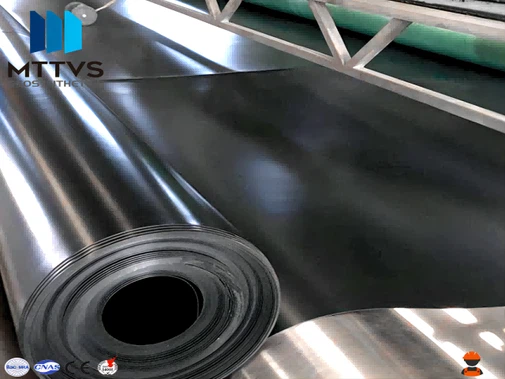
C The construction method of HDPE geomembrane is shown in the schematic diagram of the laying of geomembrane.

C.1 Welding of geomembranes
Welding equipment and procedures: There are two main methods for construction and welding of geomembrane: double-track hot-melt welding and single-track extrusion welding. The welding of the geomembrane in this project is mainly based on double-track hot-melt welding, and the connection between the impermeable membrane and the connection lock is single-track welding.
The welding process of the double-track welding machine is divided into four processes: adjusting heating, constant speed and constant temperature, lap inspection, and starting welding.
The overlapping edges of the two adjacent layers of impermeable films are heated by the electric heating wedge and then pass through the welding pressure roller. Under the pressure of the transmission pressure roller, the two layers of impermeable films are tightly bonded together.
The welding process of the double-track welding machine is divided into four processes: adjusting heating, constant speed and constant temperature, lap inspection, and starting welding. The welding of portable welding torch (monorail welding machine) is generally carried out according to four procedures: lap inspection, thermal bonding, roughening, and welding.
C.2 The schematic diagram of double-track and single-track welds is as follows:
Trial welding: When starting the welding construction in the morning and afternoon every day, the test piece must be made first, and the tensile test of the test piece must be carried out. Only after the test piece is qualified, the formal welding is allowed. The time and ambient temperature shall be marked on the test piece. The test welding shall be performed at least twice, once before starting the work, and once during the middle period; in the event of a sudden power failure of the machine or unexpected situations such as welding quality problems, it is required to reset the machine test welding. Once the test welding is passed, it is required that the temperature and speed of the machine will not be changed under the same conditions. If the test weld sample fails, the test weld must be repeated until the test weld sample passes the test.

C.3 Precautions
The geomembrane shall be laid along the length of the slope, and there shall be no horizontal joints on the slope;
The weld is balanced on the vertical slope line and should not intersect with the horizontal slope;
The distance between the horizontal joint and the toe of the slope and places with high pressure must be greater than 1.5 meters;
The grease, moisture, dust, dirt and debris on the membrane surface must be cleaned up before welding.
The welding part shall not have scratches, stains, moisture, dust and other objects that hinder welding and affect the construction quality impurities;
When the welding part needs to be polished, its width should be the same as the width of the welding seam.
The polished surface must be kept clean. When there is dirt, it should be wiped with clean cotton yarn before welding. If necessary, it should be re-polished.
Welding temperature, speed and pressure must be determined after experiment and testing;
Welding should be stopped when the ambient temperature is higher than 40°C or below -3°C;
The electrode must be consistent with the membrane material;
The overlapping length of the welded seam of the geomembrane shall not be less than 100mm;
The thickness of the weld shall not be less than 1.5 times the thickness of the film;
The testing standards for welding quality shall implement the corresponding product quality standards, but shall not be lower than the national standard requirements;
When single-track weld is used for welding, the joint part that is close to the two layers of geomembrane must be polished, otherwise the welding quality will be affected; it is forbidden to have unused extruded electrodes (granules) caused by high temperature to adhere to the geomembrane and any other geotextile layer. ;
The edge of the upper geomembrane at the weld should be ground at an inclination angle of 45° to improve the welding quality of the weld; on the edge of the wrinkled part, cut off the wrinkle of the crack to ensure a flat overlap. Extrusion weld crack or wrinkle cut
When the part is removed, the overlap should not be less than 0.1m. When the overlap is less than 0.1m, it can be supplemented by elliptical or circular patches. The patches should be expanded by more than 0.2m in all directions of the excision.
The geomembrane should avoid cross lap and adopt T-shaped staggered welding; the dislocation between transverse welds should be greater than or equal to 500mm×500mm, and repaired with 300×300mm base metal.
D Geotextile Construction Methods

D.1 Laying method
Any equipment for laying non-woven geotextiles cannot run on top of the already laid geosynthetics. When installing the non-woven geotextile on the geomembrane, the outdoor air temperature cannot be lower than -5 degrees or higher than 40 degrees.
All exposed non-woven geotextile edges must be immediately pressed with sandbags or other heavy objects. In this way, the non-woven geotextile can be prevented from being blown up by the wind and pulled out of the surrounding anchoring grooves. Non-woven geotextiles must be unfolded without strong winds to prevent them from being blown up by the wind.
The laying of non-woven geotextiles such as pulling, lifting or rolling must be carried out under controlled conditions, and some uncontrolled unfolding methods such as "free fall" are not allowed. The method of laying must ensure that the non-woven geotextile and any other underlying geosynthetics are not damaged.
Construction personnel must avoid damage to geotextiles from construction equipment or centralized personnel exchanges.
The laying method of the geotextile must ensure that the non-woven geotextile is in direct contact with the underlying geotextile to exclude wrinkles. Any wrinkling, folding or arching may cause the same to happen to other geomaterials or soil layers, so to avoid wrinkling, folding and arching, either by re-laying the geotextile according to the technical instructions or by cutting and repairs to eliminate these problems.
When the geotextile is laid on a slope greater than 10%, the number of lap joints (cross stitching) along the length of the slope must be reduced as much as possible. Geotextiles on all slopes must be at least 1.5 meters above the toe of the slope.
Geotextiles and geosynthetics covered by geotextiles must be free of mud, dust, dirt and debris that may damage the underlying geotextile or block the drainage system.
The equipment for cutting geotextiles must be approved by the engineer before use. Unprotected razors or "quick knives" cannot be used.
Construction workers must clean the work site every day, remove the debris generated during the installation of geotextiles, and place them in appropriate containers.
After all geotextiles have been installed, construction personnel together with the engineer must conduct a thorough surface inspection to determine whether there are any harmful foreign objects under the geotextiles, any damaged geotextile material or defective seams. Any foreign objects must be removed. Any damaged geotextiles or defective seams must be repaired.
D.2 Sewing of geotextiles
Unless agreed by the engineer, all stitching must be continuous (eg, point stitching is not allowed). Geotextiles must overlap a minimum of 150mm before overlapping. The minimum stitch is at least 25mm from the selvedge (the exposed edge of the material).
The sewn geotextile seams must include at least one row of double-thread lock chain seams. The thread used in the stitching must be a resin material with a minimum tension exceeding 60N, and have chemical resistance and ultraviolet resistance equivalent to or exceeding that of geotextiles.
(3) Any "missing stitches" in the sewn geotextile must be re-sewn in the affected area. (4) The construction personnel must take corresponding measures to prevent soil, particulate matter or foreign matter from entering the geotextile layer during and after installation.
E GCL Bentonite Cushion Construction Method

E.1 Laying of bentonite mat
The bentonite mat should be transported to the construction site in its original coil packaging. Before laying, the package should be opened carefully to avoid damage to the bentonite mat.
Equipment that may cause damage to the bentonite pad cannot be directly applied to the bentonite pad. If the installation equipment leaves a car mark on the foundation, the foundation must be restored to its original state before continuing to lay.
Minimize the drag of the bentonite pad on the foundation when laying the bentonite pad, so as to avoid damage to the contact surface between the bentonite pad and the ground. If necessary, a layer of temporary geotextile can be placed on the ground to reduce damage to the bentonite mat due to friction during laying.
The laying direction of the bentonite mat should be parallel to the direction of the slope.
All bentonite mats should be laid flat on the ground without any folds, especially the exposed edge areas.
(6) The bentonite mat laid on the day must be covered with backfill, geomembrane, or temporary tarpaulin.
Bentonite mats should not be left uncovered overnight. If the bentonite mat hydrates without covering, it is necessary to replace the hydrated part. If a problem with premature hydration is identified, a supervisory engineer should be consulted for a solution.
E.2 Anchorage of bentonite pad
According to the technical specifications of the construction drawing, the end of the bentonite pad should be placed in the anchoring ditch at the top of the slope, or an extension of the bentonite pad that can act as an anchor. The front end of the anchoring groove should be rounded without any sharp corners. The soft soil layer at the bottom of the anchor trench must be removed. The bentonite mat must extend completely to the bottom of the anchor trench.
E.3 Overlap of bentonite mat
The lap joint method of the bentonite pad is to overlap the edges of the two bentonite pads. The bentonite pads should be lapped in the direction of the slope to prevent the fluid from flowing into the lap joint. Make sure there are no loose soil layers or other pebbles in the lap area.
The longitudinal overlapping length of the bentonite pad should not be less than 150mm. If the non-woven fabric at the end of the bentonite pad is cut in a groove shape, the bentonite in the bentonite pad can freely enter the overlapping area. In this case, there is no need to place additional bentonite in the lap area, otherwise the lap joint needs to be reinforced with bentonite powder.Bentonite powder reinforcement is to place bentonite powder between the overlapping areas of two layers of bentonite pads. In the 150mm wide ribbon overlapping area of the bottom bentonite pad, spread sodium bentonite powder. The amount of bentonite should not be less than 0.5kg/m, and the reinforcement method of the lateral end of the bentonite pad is the same as above.
E.4 Damaged repair of bentonite mat
If the bentonite mat is damaged during installation (tears, punctures large holes, etc.), it can be repaired by cutting a "patch" from a new roll of bentonite mat to cover the damaged area. The length of the four sides of the patch from the damaged place should not be less than 300mm. Before laying the "patch", some granular bentonite or bentonite slurry should be sprinkled around the damage. Also use some adhesive if necessary to keep the "patch" from shifting.
Some granular bentonite or bentonite slurry should be sprinkled around the breakage before. Also use some adhesive if necessary to keep the "patch" from shifting.
F Construction Design of Geocomposite Drainage Network
F.1 Lay geocomposite drainage net
Unless consent is obtained, the geocomposite drainage network must be laid in strict accordance with the geocomposite laying design drawings submitted to the engineer.
Any equipment used for laying geocomposite drainage nets cannot work on the already laid geosynthetics. When laying the geocomposite drainage net on the geomembrane, the outdoor air temperature cannot be lower than -5 degrees or higher than 40 degrees.
The installer cannot expand too many geocomposite drainage mesh rolls every day so as to exceed the reasonable welding range.
(4) The edges of all exposed geocomposite drainage nets must be pressed with sandbags or other heavy objects immediately. In this way, the geocomposite drainage net can be prevented from being blown up by the wind and pulled out of the surrounding anchoring ditch. It is necessary to avoid deploying the geocomposite drainage net in the case of strong wind to prevent it from being blown up by the wind.
(5)The laying, pulling, lifting or rolling of the geocomposite drainage net must be controlled. Some uncontrolled deployment methods such as "free fall" are not allowed. The method of laying must ensure that the geocomposite drainage net and any other underlying geomaterials are not damaged.
The laying method of the composite drainage net must ensure that it will not cause folds or folds of the geocomposite drainage net or the underlying geotechnical material, which will cause wrinkles and arches. Therefore, in order to avoid wrinkling, folding and arching, these problems are eliminated by re-laying of the geomaterial or by cutting and repairing.
The construction personnel must try to protect the laid geocomposite material and avoid possible damage caused by the construction machine. Any damage to the geocomposite or other geocomposite due to the above reasons must be repaired.
When the geocomposite drainage net is laid on a slope with a slope greater than 10%, the number of horizontal laps (welding) should be minimized in the extension of the slope. All geocomposite drainage nets must be at least 1.5 meters above the toe of the slope.
The geocomposite drainage net must not damage the underlying geotechnical materials or block the geocomposite drainage net, such as mud, dust, dirt and debris. Geocomposite drainage net cannot be welded with geomembrane.
The equipment for cutting the geocomposite drainage net must be approved by the engineer before it can be used. Unprotected razors or "quick knives" cannot be used.
Construction workers must clean the work site every day, remove and properly dispose of the debris generated during the installation of the geocomposite drainage net, and put them in appropriate containers.
(12) After all geocomposite drainage nets are installed, construction personnel and engineers must conduct a thorough surface inspection to determine that there are no foreign objects, damaged geocomposite drainage nets, or damaged geocomposite drainage nets under the geocomposite drainage nets. Defective seams. Any foreign objects must be removed. Any damaged geocomposite drainage mesh or defective seams must be repaired.
F.2 Binding and sewing geocomposite drainage net
Unless agreed, the geonet portion of the geocomposite drainage mesh must overlap by a minimum of 75mm or as recommended by the manufacturer prior to bundling. Any geotextiles must be removed from between the overlapping portions of the geonet.
If the engineer does not approve other binding tools, the overlapping part of the geonet must be tied with at least one line of light-colored plastic wire. The binding device must be free of any metal parts and have a tension equal to or greater than 200N. The bindings must be located in the middle of the overlap and must pass through more than one axis of the geonet.
The binding spacing of the geonet along the slope is 1,500 mm, and the binding spacing between the anchoring ditch and the seams at the bottom of the landfill is 150 mm.
Once bundled, the upper layers of the geotextile for the geocomposite drainage mesh portion must overlap by a minimum of 150mm, or be sewn together continuously according to the manufacturer's recommendations.
Sewing geotextile seams must include at least 1 row of double-thread stitches. The thread used in sewing must have a minimum tension of more than 60N in multiple strands and have resistance to chemical corrosion and ultraviolet light equivalent to or exceeding that of geotextiles.
If there is a "missing stitch", the affected area must be re-sewed.
(7) The construction personnel shall ensure that soil, stones or foreign materials are prevented from entering or separating in the middle of the geotechnical materials during or after the installation of the geotechnical composite materials.
F.3 Defects and Repairs
Construction personnel must inspect all geocomposite drainage nets, joints and repairs that may be damaged and/or defective due to fabrication or installation. Any defective connections should be clearly marked on the geocomposite drainage net and repaired in time.
If the defect is greater than 1 meter, the geocomposite drainage network shall be repaired as follows:
At the bottom of the landfill, the damaged area is cut off and the two-part geocomposite drainage mesh is connected as described in Section 2.5.
On slopes, damaged geocomposite drainage mesh rolls are to be removed and replaced.
If the defect is less than 1mx1m, the geocomposite drainage network shall be repaired as follows:
If the geonet is not damaged but the geotextile is damaged, use heat welding to repair the damaged place with 300mm overlapping patches.
If the geonet is damaged, cut off the damaged geonet. Take a piece of geonet to replace the damaged part and tie it to the existing geonet every 150mm with white plastic bindings. A patch of geotextile with a 30mm overlap was added to the geonet by thermal welding.
G Anchor Ditch Backfill

When backfilling, manual backfilling and small mechanical compaction shall be used, and mechanical backfilling shall not be used to prevent mechanical fracturing of the geomembrane and non-woven fabric, which will lead to the leakage of garbage liquid and pollute the water quality and soil.
Before manual backfilling and ramming, the backfill should be initially leveled, and the ramming should be carried out in a certain direction. When tamping the foundation trench and the floor, the ramming route should start from the four sides, and then ram to the middle.
When tamping with small equipment such as frog rammers, the fill should be preliminarily leveled before ramming, and the rammers ram in turn, evenly separated, without leaving any interval.
The backfill of foundation pit (slot) should be backfilled and compacted at the same time on opposite sides or around. When backfilling the pipe trench, the soil should be filled and compacted around the pipe first, and it should be done from both sides of the pipe at the same time. If there is groundwater or stagnant water in the filling layer, drainage ditches and water collecting wells should be set around to lower the water level.
If the filled soil layer is flooded, the thin mud should be removed before backfilling the upper layer; the filling area should maintain a certain horizontal slope, or slightly higher in the middle and lower on both sides to facilitate drainage; the filling should be done on the same day compaction.
During the rainy season, the backfilling of foundation pits (slots) or pipe trenches should not be too large, and should be completed section by section and section by section. The processes from earth moving, laying and filling to compaction should be carried out continuously. Before the rain, the filled soil layer should be pressed and a certain slope should be formed to facilitate drainage. During the construction, the drainage facilities should be checked and dredged to prevent the ground water from flowing into the pit (slot), causing the slope to collapse or the foundation soil to be damaged.
H Technical Feasibility Analysis of the Proposed Rain and Sewage Diversion Project

Rain and sewage diversion technology for domestic waste landfills is a new method developed and applied in recent years. We visited Shangqiu The rain and sewage diversion project of the municipal domestic garbage field believes that this measure is convenient and quick to implement, and the problem is relatively comprehensive.It can not only prevent rainwater from entering the garbage and become leachate, but also effectively solve the problem of the odor of the garbage dump and the diffusion of solid waste with the wind The problem.
The basic principle of this measure is: first, shape the garbage heap, cover the surface with plain soil of 30~40cm, and repair it.Flat shape, 300g geotextile and HDPE (High Density Polyethylene) geomembrane are used on the surface of the pile, which will not require .Area coverage for landfill operations. In this way, due to the isolation effect of HDPE geomembrane, rainwater no longer enters the garbage.The garbage dump is directly discharged to the outside of the site through the designed rainwater drainage system, so as to reduce the production of leachate.Purpose. At the same time, due to the barrier effect of HDPE geomembrane, the area covered with HDPE geomembrane will no longer be scattered.No odor, no more mosquitoes and flies, and no more debris floating around in the wind.
Due to the leakage of leachate around the slope foot of the garbage dump, if the rain and sewage diversion measures are implemented, it is necessary to Leachate drainage ditches are arranged around the slope foot of the heap. Rainwater drainage ditch is set on the upper part of the leachate drainage ditch, and the drainage ditch is placed in the A small amount of gravel and rainwater enter the original flood interception ditch through the underditch and through the Huanchang Road.
Rain and sewage diversion coverage plan location map


Since the garbage dump will continue to landfill garbage, when designing the scheme, the actual situation of the later garbage dump should be considered.international operations. On the platform at the top of the garbage dump, consider taking the working road as the criterion, and divide the platform into two parts: east and west Areas, each half of the area will take turns to landfill for one year. When implementing rainwater and sewage diversion construction, the platform only covers the eastern half of the area and all surrounding slopes. The HDPE geomembrane covered area is adjacent to the side of the working road, and a 1-meter-wide geomembrane is used.The edge of the cloth is pressed, and then a layer of woven soil bag is pressed on the top to prevent wind and consolidate (this method is also used for the top of the slope in the western half); wait for the western half After the area is filled to a certain height and covered with soil and leveled, the HDPE geomembrane on the platform in this half area is cut open and moved to the filling area.
The platform in the western half of the good garbage (if the geomembrane is not enough, you can purchase a small amount) to cover it. this way,It not only ensures the effect of rain and sewage diversion, saves money, but also ensures the normal operation and production of the landfill.
I Technical scheme for the construction of biogas guide and exhaust wells
There are 10 biogas guide and exhaust wells to be built (see the figure below for the plane distribution). When constructing biogas guide and exhaust wells, The upper leachate recharge facility can not only guide and discharge biogas, but also recharge leachate. Recharged leachate, with the waste in the organic components react, and part of the leachate will be converted into biogas and discharged, which can effectively reduce the leachate. It is expected that every the amount of leachate recharged in a well can reach 10-30 tons per day (the amount of recharge varies with the season).
I.1 Plane layout of biogas guide and exhaust wells

I.2 Schematic diagram of biogas guide and exhaust well section

I.3 Structural drawing of steel cage for biogas guide and exhaust well

Processing connection: welding.
J Detailed description of the construction of biogas guide and exhaust wells
J.1 The biogas drainage well of the project is relatively deep, with an estimated depth of 14 meters, and the biogas is easy to concentrate, so it cannot be extracted.Drilling method is used; only open excavation can be used. It is planned to use a long-arm excavator to excavate a deep radius.It is a circular arc trench with a width of 14 meters and a width of 1 meter. Considering the factors of garbage collapse, the actual effective excavation width will be within 1.5~2 meters to ensure that the actual use width reaches 1 meter. As shown below:

J.2 Due to the concentration of biogas, in the process of filling the cage with pebbles, sparks are easily generated when the stones collide with each other, causing explode. Therefore, the biogas steel cage should be divided into sections every 2 meters, welded in sections outside the site, and transported to the site in sections.Installation, manual filling of pebbles in sections, installation and backfilling section by section, and stacking and lifting section by section. During the filling process,Use an explosion-proof blower to ventilate to ensure safety; manual stone filling should be handled with care to avoid sparks caused by collision of stones Biogas explosion to ensure safety.
J.3 When installing the biogas cage, the composite drainage network is laid in layers at the same time. When the leachate is recharged, the leachate can be discharged.It can be scattered into the garbage pile along the gap of the composite drainage net to ensure that the recharged leachate can be effectively dispersed into the garbage.Let the garbage continue to ferment until it stabilizes.
K Sketch of the construction scheme of the floating cover project
K.1 Plane Schematic

K.2 Sectional diagram


