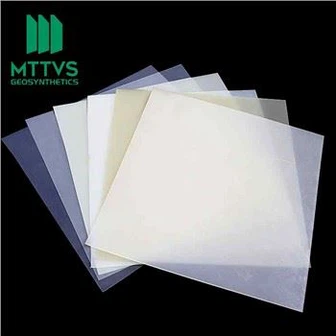
Construction of geomembrane for anti-seepage of workshop floor
Construction of geomembrane for anti-seepage of workshop floor

1. The ground anti-seepage layer can use clay, impermeable concrete, high-density polyethylene (HDPE) film, sodium based bentonite waterproof blanket or other materials with equivalent anti-seepage performance.
2. When the construction site has clay that meets the requirements, a clay anti-seepage layer should be used for ground anti-seepage. The top surface of the anti-seepage layer should be made of concrete or a sand and gravel layer with a thickness of no less than 200mm should be set.
3. The concrete anti-seepage layer can use impermeable steel fiber concrete, impermeable synthetic fiber concrete, impermeable reinforced concrete, and impermeable plain concrete.
4. The durability of the concrete anti-seepage layer should comply with the relevant provisions of the current national standard "Code for Design of Concrete Structures" GB 50010, and should also comply with the following provisions:
(1) The strength grade of concrete should not be lower than C25, the impermeability grade should not be lower than P6, and the thickness should not be less than 100mm.
(2) The volume fraction of steel fibers should be between 0.25% and 1.00%.
(3) The volume fraction of synthetic fibers should be between 0.10% and 0.20%.
(4) The mix proportion design of concrete should comply with the relevant provisions of the current industry standards JGJ 55 for ordinary concrete mix proportion design and JGJ/T 221 for fiber reinforced concrete application technology.
5. The concrete anti-seepage layer should be equipped with contraction and expansion joints, and should comply with the following regulations:
(1) Vertical and horizontal contraction and expansion joints should intersect vertically.
(2) The spacing between contraction and expansion joints should comply with the provisions of Table 5.2.5.
6. Shrinkage joints should be cut, with a width of 6mm to 10mm and a depth of 16mm to 25mm. The depth of the joint sealing material should be between 6mm and 10mm; The joint should be filled with sealing material and backing material, and the surface of the sealing material should be lower than the ground. It can be taken as 2mm to 3mm at low temperatures and not more than 2mm at high temperatures.
7. The width of the expansion joint should be between 20mm and 30mm; The width to depth ratio of the sealing material for caulking should be 2:1, and the depth should be between 10mm and 15mm. The joint should be filled with caulking board, backing material, and caulking sealing material (Figure 5.2.7). The surface of the caulking sealing material should be lower than the ground, and can be taken as 2mm to 3mm at low temperatures, and should not exceed 2mm at high temperatures.
8. The concrete anti-seepage layer should have a joint at the junction of walls, columns, and foundations, with a joint width of 20mm to 30mm. The width to depth ratio of the sealing material for caulking should be 2:1, and the depth should be between 10mm and 15mm. The joint should be filled with a joint board, backing material, and joint sealing material.