


Filament spunbond needle punched non-woven geotextile
Filament spunbond needle punched
non-woven geotextile
Classification
Filament spunbond needle punched non-woven geotextiles are classified into polyester (PET), polypropylene (PP), nylon (PA), ethylene glycol (PE), etc. according to fiber types. It is divided into ordinary type and composite type according to structure.
Features
Geotextile is a permeable geosynthetic material that exists between soil and pipelines, gabions, or retaining walls, enhancing water movement and hindering soil movement.
The long filament geotextile is made of high-strength polyester chips as raw materials, which are sprayed, stretched by air flow, laid with mesh, pre pressed, and needle punched.
- Stable physical performance, able to maintain original performance for a long time;
- Stable chemical properties with strong acid and alkali resistance; Good permeability;
- High temperature resistance, cold resistance, and adaptability to different external environments;
- Lightweight, can be packaged, transported, and stored according to certain requirements, and construction is convenient.

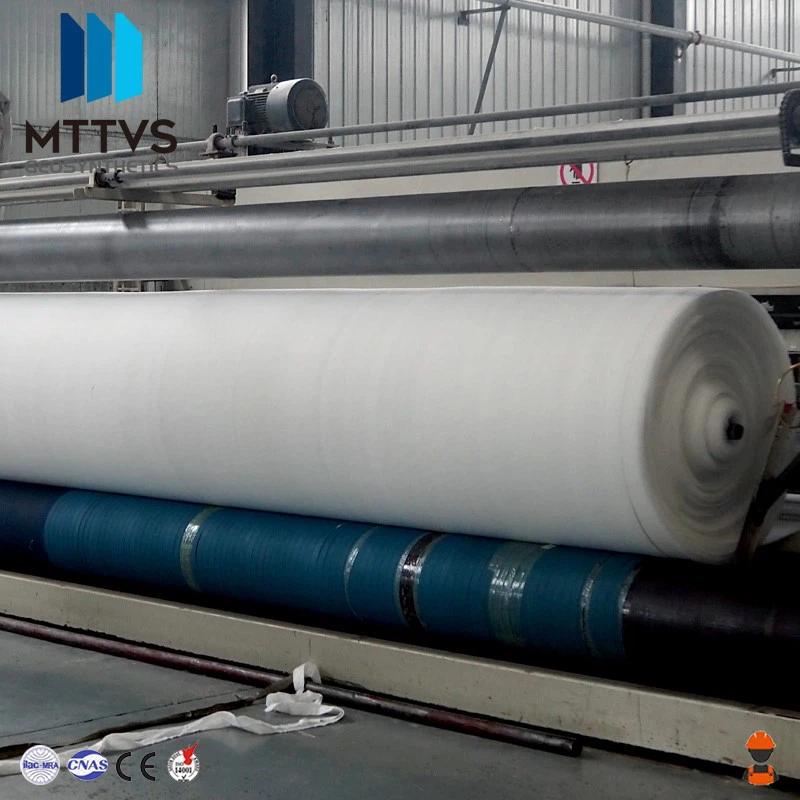
Production process
The needle punched non-woven fabric series products are formed through fine combing, multiple precise needle punctures, or appropriate hot rolling treatment. Long filament needle punched non-woven fabric is a process of weaving and laying jet stretched fibers into a fiber mesh, then pre pressing the fiber mesh through an overheated roller and reinforcing it into a fabric through a needle. The needle has hooks and thorns, and the fiber mesh is repeatedly punctured and reinforced with hooks and straps to form a needle punched non-woven fabric.
Application

It can stabilize and limit the displacement of civil engineering during long-term use, and can transfer or distribute local stress acting on the soil to a larger area, increasing the frictional resistance between the soil and geotextile.
Mainly used in the following projects: in highways, railways, embankments, earth and rock dams, airports, sports fields, etc., to strengthen weak foundations while playing the role of isolation and filtration; Increase the stability of gravel slopes and reinforced soil; Placing geotextiles on the foundation of a construction site can serve functions such as reinforcement, isolation, and filtration.
Isolation
Separate different soil structures with geotextiles to form stable interfaces, allowing each layer of structure to separate and play its own characteristics and overall role according to requirements.
Mainly used for: isolation between railway ballast and roadbed, or isolation between roadbed and soft foundation; The isolation layer between the surface and foundation of highways, railways, airports, parking lots, etc; In soil rock mixed dams, separate different dam building materials. Building earth rock dams on rock foundations with developed cracks or pebble foundations to serve as isolation between the dam body and the foundation; Isolation between gabions, sandbags, or soil bags and weak foundations; The isolation layer between artificial filling, rock filling, or material yard and foundation, as well as the isolation between different frozen soil layers; In water (rivers, lakes, seas), soil and rock are dumped and filled. Geotextiles are placed underwater to provide isolation, as well as to filter and reinforce the soil.


Protective
Polyester filament geosynthetic materials can provide protection and erosion resistance to soil or water surfaces.
Mainly used for the following projects: placing geotextiles on the bank slopes of rivers, lakes, and seas to prevent erosion in water flow; Prevent the diffusion and spread of harmful substances such as garbage, waste, and waste liquid to pollute water or the environment; Prevent water surface evaporation or dust pollution from the air; Prevent reflection cracks on the road surface; Prevent soil freezing damage at low temperatures; Temporary protection of the shore or grassland to prevent water loss and promote plant growth; Measures taken in underground engineering construction to prevent impact on adjacent buildings; Prevent interference or damage caused by vibrations such as machine foundations, or explosions in ammunition depots that damage life and property; Prevent chemical substances from corroding and damaging engineering structures.
Filtering
Geotextiles can allow water to pass through and effectively prevent soil particles from passing through, thereby preventing soil particle loss and causing soil damage.
Mainly used for the following projects: filter layer for clay core walls or clay inclined walls of earth and rock dams; The filter layer of various drainage bodies inside earth and rock dams (including roller compacted dams, water falling dams, and water dumping dams) or embankments; Filter layer on the surface of ash storage dam or ore storage dam; The filter layer of embankment, dam, river, canal, and coastal block stones or concrete slope protection; The downstream embankment of the water gate, sea surface temperature, or filter layer below the slope protection; The filter layer of the drainage system in the backfill soil of the retaining wall; Filter layers around drainage pipes or gravel drainage ditches; Filter layers for water wells, pressure relief wells, or inclined pipes in hydraulic engineering; The isolation layer of geotextile between road, airport, railway ballast, and foundation.

05 Drainage
Polyester filament non-woven geotextile can form drainage channels in the soil, collecting water in the soil and discharging it along the plane of the material.
Mainly used for the following projects: vertical or horizontal drainage inside earth dams; Drainage behind the anti-seepage geotextile membrane or below the concrete cover in earth dams or embankments; Buried in soil to dissipate pore water pressure; Vertical drainage in weak treatment; Drainage behind retaining walls; Drainage around each building; Eliminate water seepage around the tunnel and reduce the external water pressure borne by the lining; Drainage of artificial fill foundation or sports field foundation.
06 Anti-seepage
The geosynthetic material formed by the combination of geotextile and geomembrane can prevent liquid leakage, gas volatilization, and protect the safety of the environment or buildings.
Mainly used for the following projects: anti-seepage measures for the surface and body of earth rock dams, upstream paving or storage areas; Vertical anti-seepage of earth dams or sluice foundations or vertical anti-seepage of underground reservoirs; The upstream apron of the water gate is used for slope prevention and seepage prevention. Canal seepage prevention; Low pressure input pipelines within the irrigation area; There are anti-seepage measures for culverts buried in embankments around the tunnel; Inflatable membrane dam, pile membrane cofferdam; The anti-seepage measures for drinking water pools, swimming pools, fish and duck farming pools, sewage pools, brine pools in salt fields, storage pools for various chemical solutions, and oil storage pools; Basements, underground warehouses, and underground parking garages have anti-seepage and moisture-proof measures for air defense passages and other buildings; Layer top anti-seepage; Polluting rivers, oil transportation channels, and various industrial waste channels for hydraulic transportation. Anti seepage measures for solid waste dumping sites; Sealing of expansive soil, cutting off the water source of frozen and swollen soil.
07 Other functions
Long filament non-woven geotextiles can be combined with other geosynthetic materials such as geogrids, geomembranes, drainage networks, etc. to form composite geotextiles. Composite geotechnical materials can combine the properties of different materials, better meet the needs of specific engineering, and play a variety of functional roles. Composite geogrid is a composite geosynthetic material made by heating and bonding geotextiles and plastic geogrids. Geogrid has a high tensile modulus, which can provide strong confinement and reinforcement, while non-woven fabric ensures the filtration function of the composite material. Another example is the composite drainage network, which is a composite drainage material composed of non-woven geotextile and drainage network. The combination of geotextile (filtration function) and three-dimensional geotextile drainage network (drainage and load dispersion function) provides a complete filtration, drainage, and protection system. Geotextile can provide the function of water supply/soil filter layer and prevent clay and the filling material above from embedding into the drainage network core, thus ensuring its long-term drainage capacity.
Parameters of filament non-woven geotextile

Product packaging, storage, transportation, and labeling
1.Filament spunbond needle punched nonwoven geotextile is packaged in rolls according to fixed length, and the fixed length value is specified in the agreement or contract.
2. During storage and transportation, the product should be ensured to be free from damage, contamination, moisture, rain, and long-term exposure to sunlight.
3. Each roll of product should have a clear mark in a prominent position, including the following content:
a) The name and address of the production enterprise;
b) Product name;
c) Product code;
d) Execution standard number;
e) Roll length and net weight
f) Production batch number;
g) Production date;
h) Inspection certificate.


